
Kiosk Versus Retail Dessert Store: Which Wins?
Compare a kiosk versus retail dessert store for foot traffic, costs, labour and growth. Choose the format that suits your location, capital and ambition.
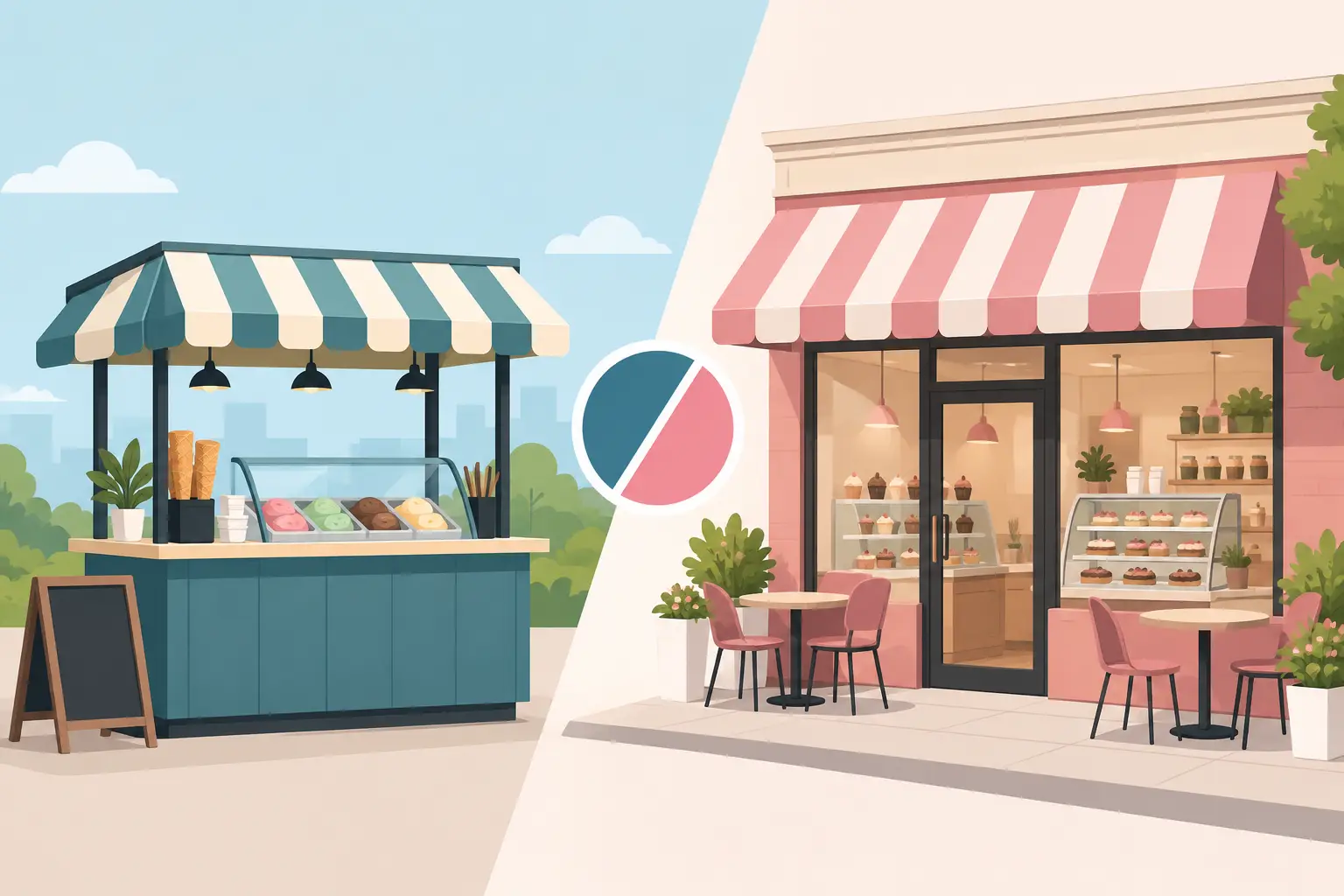
A dessert site can look busy, bright and highly shareable in almost any format. But a kiosk versus retail dessert store decision changes far more than the size of your counter. It affects your rent exposure, staffing model, trading hours, menu range, customer flow and the kind of business you can build over time.
For an aspiring franchisee, the right answer is rarely about choosing the biggest space or the lowest upfront number. It is about matching the format to the site, the local customer and your growth plan. A compact kiosk can be a smart, high-energy entry into a strong centre. A full retail store can give your brand room to become part of a neighbourhood routine. Both can work. Both need to earn their footprint.
Kiosk versus retail dessert store: the commercial difference
A kiosk is built for visibility and speed. Usually positioned in a shopping centre, food hall, transport-linked precinct or high-traffic retail zone, it puts the product in front of customers already on the move. The best kiosks make it easy for someone to see the menu, understand the offer and make a quick decision. For frozen yoghurt, matcha soft-serve and colourful desserts, that visual pull matters.
A retail dessert store gives you more control over the full customer experience. You have a proper shopfront, more room for signage and merchandising, and often more capacity for seating, group visits and longer dwell time. It can support a broader menu and create a stronger local presence, particularly on a high street or in a lifestyle precinct where customers return throughout the week.
The trade-off is straightforward. Kiosks generally need less space and can operate with a tighter team, but they rely heavily on passing traffic and centre conditions. Retail stores can build greater destination value, but typically carry more fit-out, occupancy and operational complexity. Neither format is automatically more profitable. The quality of the site and the discipline of the operation will matter more than the label on the lease.
When a kiosk makes commercial sense
A kiosk is often the right move when the site does the heavy lifting. Think strong pedestrian flow, a visible position near fashion, entertainment, supermarkets or food outlets, and a customer base that is already open to an afternoon treat or quick post-shop reward.
For a youth-led dessert brand, kiosks can create the kind of theatre people notice. Customers can watch the self-serve frozen yoghurt journey, see the toppings, spot the matcha colour and take a photo before they have even reached the counter. This is not just decoration. A format that is easy to understand from several metres away can convert casual foot traffic into transactions.
The operational case is just as important. A smaller footprint can mean lower labour requirements, shorter cleaning runs and less space to manage. It may suit an owner-operator who wants to be hands-on without taking on the staffing structure of a larger shop. It can also be a practical first store for someone entering hospitality from another industry, provided they have the right training, systems and support around them.
What a kiosk cannot hide
Kiosks are exposed to the rhythm of the centre. If foot traffic shifts because of construction, a tenancy change or seasonal shopping patterns, you feel it quickly. There is limited space to recover through extra seating, private events or a large dine-in offer.
Storage can also be tighter. That calls for disciplined ordering, reliable supply chain planning and a menu designed for the footprint. A kiosk should not try to be a full restaurant squeezed into a few square metres. Its advantage is focus: a menu people crave, delivered quickly and consistently.
Before committing, look beyond a centre's headline footfall. Ask where people actually walk, whether they pass your exact location, what time they move through the precinct and whether nearby retailers attract your customer. A great-looking kiosk near a weak traffic corridor is still a weak site.
When a retail dessert store is the better play
A retail store can be the stronger choice when the location supports a destination, not just an impulse purchase. High streets, dining precincts, mixed-use developments and family-oriented suburban hubs can reward a store that gives customers a reason to stop, stay and come back.
More space can create more reasons to visit. Seating makes it easier for friends to meet after school or work. A larger frontage lets the brand tell a clearer story. More back-of-house capacity can support a wider product mix, better stock holding and smoother peak-period operations. If your local market has strong evening trade, a retail store may also offer greater room to capture the dinner-to-dessert occasion.
For growth-minded operators, a full store can become a valuable proof point. It lets you learn how your local market responds to different dayparts, seasonal specials and community activity. It can also give you a more substantial platform for building a team, developing supervisors and preparing for a multi-site portfolio.
The extra space comes with extra responsibility
A larger tenancy creates more opportunities, but it asks more of the operator. Rent, outgoings, fit-out scope, utilities, cleaning and labour all need to be considered against realistic sales potential. A beautiful store is not a business plan.
You will also need enough demand to justify the additional capacity. A strip shop in the right neighbourhood can outperform a larger retail tenancy in the wrong one, but it may require more local-area marketing and stronger day-to-day owner involvement to establish its customer base.
This is where brand support has real value. Site assessment, lease guidance, store design, recipes, training and launch planning can reduce the number of expensive decisions a first-time operator has to make alone. Hospitality experience is useful, but a clear system and the willingness to lead your business well are often more important.
Compare the site before you compare the format
The most useful question is not, “Do I want a kiosk or a store?” It is, “What will this particular location allow me to do well?”
Start with the customer. A CBD food hall might deliver sharp weekday lunch and afternoon peaks, while a suburban shopping centre may be strongest on weekends and after school. A high-street site near gyms, cinemas, restaurants or family services may have a different mix again. Your format should fit those habits.
Then look at visibility. Can customers see the product from a distance? Is the frontage clear? Is there room for a queue without blocking other tenants? Dessert is a visual category, and a site that lets people see the colour, movement and choice behind the counter has a genuine advantage.
Finally, test the operating reality. Consider delivery access, waste removal, storage, nearby competition, landlord requirements and trading-hour obligations. The details are not glamorous, but they shape margins every day.
Investment, ambition and the first-store decision
Your first format should suit your available capital and the level of involvement you want to bring. Lower complexity can be appealing, but the cheapest option is not always the best value. A site with weak traffic or restrictive operating conditions can cost far more than it saves.
At YOVIE, the franchise investment starts from $350K + GST, with at least $150K in liquid capital required. The aim is not to push every operator into one type of tenancy. It is to assess the opportunity properly, then build a format that supports the local site, the brand experience and a business built to grow.
A kiosk may suit the franchisee looking for a focused, efficient first operation in a high-traffic environment. A retail store may better suit an operator with a strong local site, larger ambitions and the appetite to build a fuller customer destination. In either case, the fundamentals remain the same: quality product, an attractive experience, reliable team training and consistent daily execution.
Choose the format you can lead well
There is no prize for taking more space than your market needs. There is also no advantage in choosing a kiosk if the site cannot give you the traffic required to make speed and visibility work.
The right format is the one that gives customers an easy reason to walk in, return and bring someone with them - while giving you an operation you can run with confidence. Start with the site, pressure-test the numbers and choose the footprint that makes your next move stronger.